
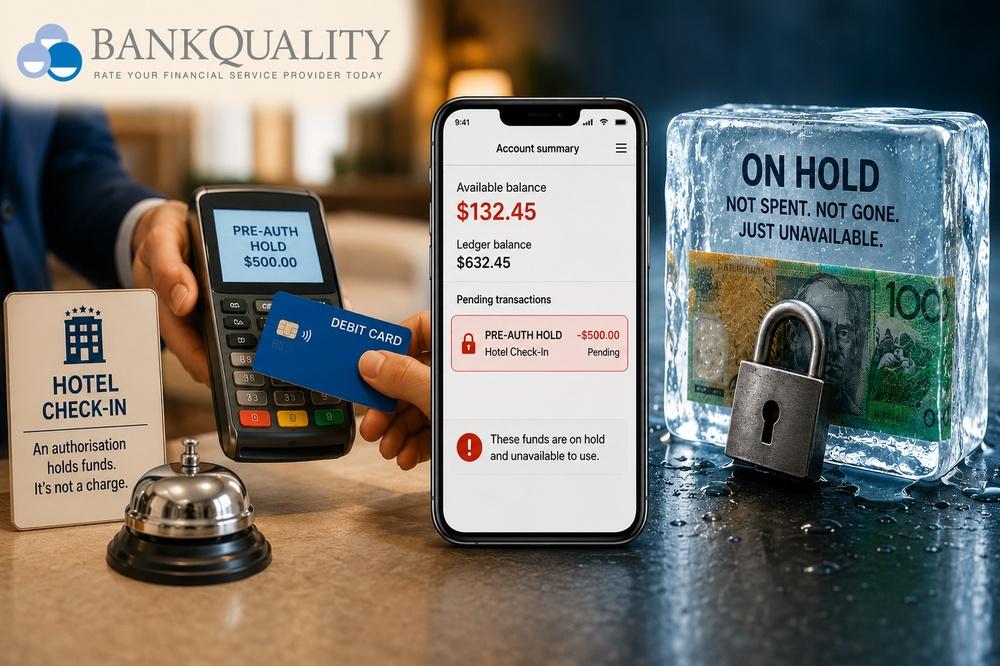
Pre-authorisation holds are not fees or final charges, but they can temporarily reduce customers’ usable money, especially on debit cards.
Customers may experience pre-authorisation holds as a payment mechanism that protects merchants against insufficient funds, but without disclosure or clear reversal timelines, they can appear indistinguishable from hidden charges.
A traveller checks into a hotel and pays with a debit card. The room rate is known, but the hotel also needs protection against possible room service, minibar use or damage. Instead of charging only the final bill, the merchant places a pre-authorisation hold for an estimated amount. The customer has not paid that amount, but the bank treats it as unavailable until the transaction is completed, reversed or expires.
This mechanism is a standard part of card payments. Visa guidance allows estimated authorisations where the final transaction amount is not yet known, and says authorisation reversals are used to tell the issuer that all or part of a hold should be removed. Mastercard rules similarly require issuers to release holds once authorisations are matched to the clearing record.
The problem is not that pre-authorisation exists. Hotels, car rental companies and fuel stations use it because the final amount may be uncertain when the card is first presented. Consumer guidance has long recognised this practice, often described as “card blocking”, at hotels, gas stations, restaurants and rental-car counters.
The risk is that the hold can reduce liquidity before the customer realises what has happened. On a credit card, the hold reduces available credit. On a debit card, it can reduce the balance available for rent, groceries, transport or other payments. The customer may still have money in the account, but not all of it is usable while the hold remains pending.
Hold amounts can also exceed the final bill. Hotels and rental-car firms often include estimated incidentals, fuel, deposits or other potential charges in the authorised amount. Visa lodging guidance states that if the actual transaction amount is lower than the estimated authorisation, the merchant must process an authorisation reversal for the difference.
A hold may clear quickly when the merchant submits the final transaction and any necessary reversal correctly. It may last longer if settlement is delayed, if the merchant does not process the reversal properly, or if the issuer’s systems take time to update the available balance. For consumers, the practical result is the same: funds that appear to belong to them may be unavailable for days.
Card-network rules require merchants in some circumstances to inform cardholders that an authorisation is estimated and to provide the authorisation amount. But in practice, customers may still discover the hold only through a reduced available balance or a pending transaction in their banking app. That gap between formal rules and customer experience is where confusion often arises.
Cardholders can reduce the risk by asking hotels, car rental firms and fuel stations how much will be authorised before presenting a card. Where possible, using a credit card for deposits and uncertain final amounts can protect cash balances. Customers using debit cards should check both ledger balance and available balance, because the difference often reflects pending transactions and holds.
Pre-authorisation holds are not hidden fees. They are a structural feature of card payment processing. But for households with limited balances, a temporary freeze can have the same practical effect as a charge: money becomes unavailable when it is needed. The consumer issue is therefore not only cost, but clarity. Customers should know how much is being held, why it is being held and when the unused amount is likely to be released.
"Don't hesitate anymore! Now, at BankQuality, Talk it all out with a relaxed mind about the services, behaviour and products of your banks! Review and Rate your Bank TODAY! #TalktoBQ — www.bankquality.com"